
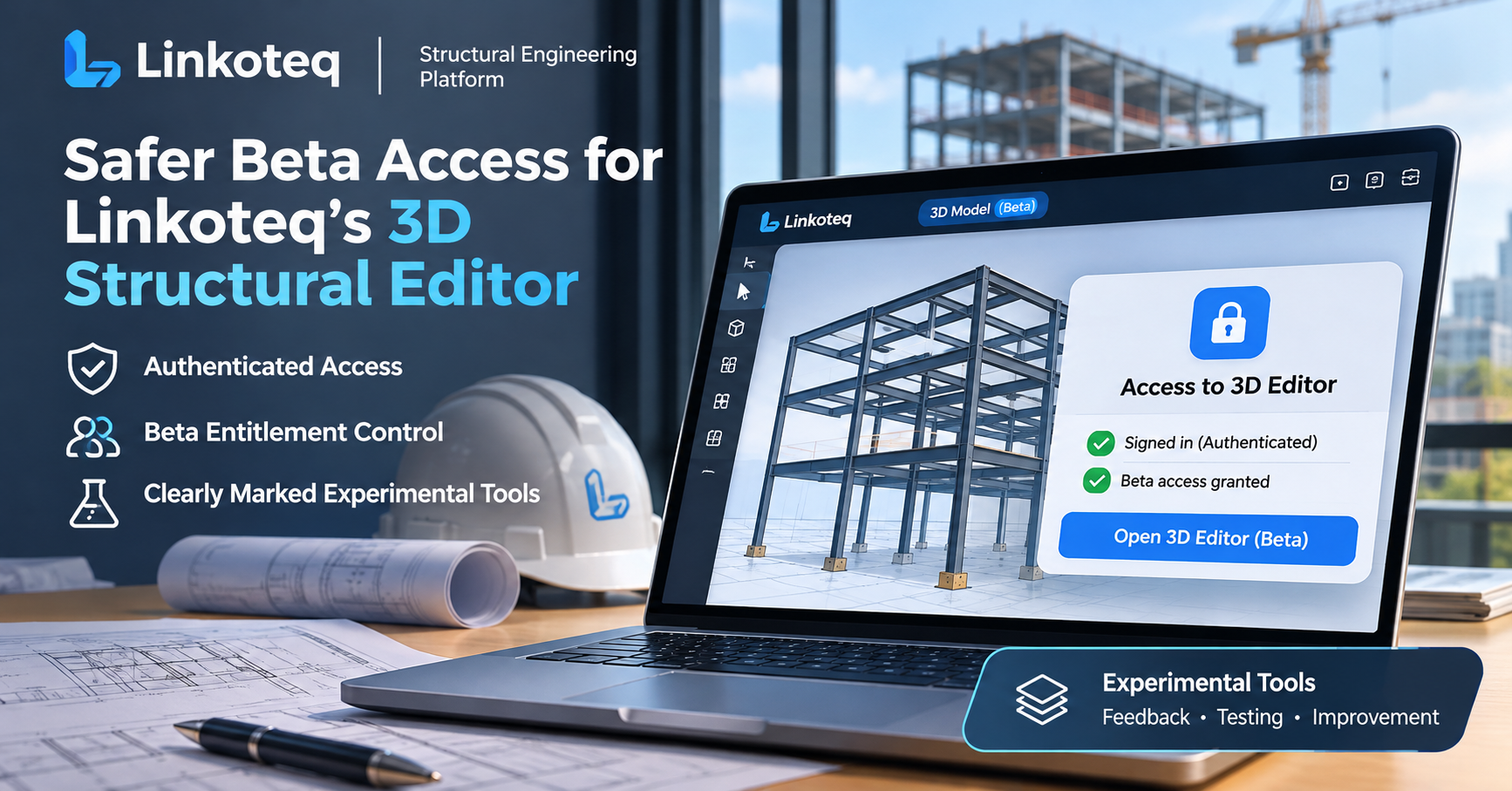
Safer Beta Access for Linkoteq’s 3D Structural Editor
November 9 commits introduced and tested deny-by-default Beta access checks for Linkoteq’s 3D structural editor. Here is what they verify—and what remains unproven.
Why access controls matter in engineering software
A structural model can look convincing long before every editing, import, or analysis workflow has been validated. For a developing engineering tool, the responsible approach is to distinguish experimental capabilities from production-ready calculations and control who can use each stage.
Linkoteq’s recent 3D Model repository work focuses on exactly that boundary: a customer-access adapter that checks authenticated identity and an explicit Beta entitlement before permitting access. This is an access-control milestone, not evidence that all 3D editing features are complete or that the software performs certified structural design.
What changed in the code
On November 9, 2026, the 3D Model repository added a shared Supabase customer-entitlement verifier, followed by automated tests for its deny-by-default behavior. The test cases explicitly cover three distinct outcomes: an absent authentication token is rejected, an authenticated identity without an owner-approved grant is rejected, and an identity with an active Beta grant can be allowed.
This separation matters. Signing in establishes who is requesting access; it does not by itself establish authorization to run an unfinished engineering tool. An explicit Beta grant provides a separate control point for limited testing and feedback.
A practical example
Consider an engineer evaluating a conceptual steel frame. The engineer may want to open a model, inspect the grid, or explore a preliminary layout. Before the Beta editor is available, the platform should verify that the account is authenticated and that the account has an appropriate tool entitlement. If either check fails, the application should not silently grant access.
For teams, this creates a clearer distinction between exploratory modeling and verified engineering deliverables. It also reduces the risk of a visitor mistaking an experimental interface for a finished design product. The access layer does not, however, replace engineering verification of geometry, loads, member properties, or results.
What the tests establish—and what they do not
The November 9 test commit demonstrates that the adapter was exercised against mocked identity and entitlement responses. It is evidence of intended access-control behavior at the tested code boundary. It is not an end-to-end demonstration of every deployed route, browser session, mobile interaction, or model-editing command.
In particular, this change does not establish that SAP2000 imports are lossless, that imported elements are fully editable, or that structural calculations are ready for professional reliance. Those workflows require their own regression tests, user acceptance checks, and qualified engineering review.
How this fits Linkoteq’s roadmap
Linkoteq is building accessible online structural-engineering workflows while exploring faster early-stage decisions for architects, engineers, and project teams. A controlled Beta program supports that direction by allowing feedback on incomplete tools without presenting them as finished services.
The near-term engineering objective is straightforward: test individual capabilities, document limitations, and improve model interaction and data exchange. Longer-term possibilities such as proposal-stage section comparisons or material optimization remain development goals unless separately validated.
Evidence and next steps
The source evidence is available in the official customer-entitlement verifier commit and the deny-by-default test commit, both dated November 9, 2026. Readers evaluating the Beta should request appropriate access, confirm the current tool limitations, and independently verify any engineering output before using it in a project.
Bottom line: safer access to an experimental structural editor is a meaningful software milestone. It is not a substitute for a validated structural model or professional engineering judgment.